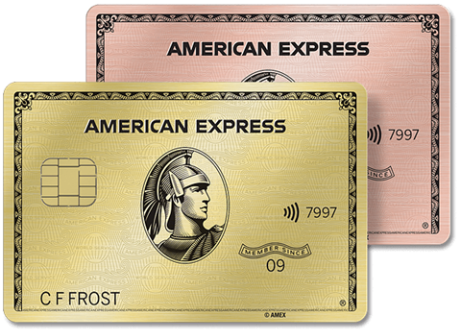
These two cards both have "premium" in their pitch and "Amex" on the front, but they're aimed at different people doing different things with their spending.
The Gold is a food and dining card. The Platinum is a travel and lounge card. Picking the right one comes down to where your spending actually goes — not where you wish it went.
The annual fees
| Amex Gold | Amex Platinum | |
|---|---|---|
| Annual fee | $325 | $695 |
| Welcome bonus | 60,000 points after $6,000 in 6 months | 80,000 points after $8,000 in 6 months |
| Foreign transaction fee | None | None |
That's a $370 difference per year. The Platinum has to deliver $370 more in value than the Gold for it to make sense — and it does, but only for the right person.
Earning rates
Amex Gold:
- 4x Membership Rewards points at restaurants worldwide
- 4x at US supermarkets (capped at $25,000/year, then 1x)
- 3x on flights booked directly with airlines or amextravel.com
- 1x on everything else
Amex Platinum:
- 5x on flights booked directly with airlines or through Amex Travel (up to $500,000/year)
- 5x on prepaid hotels booked through Amex Travel
- 1x on everything else
Notice what's missing on the Platinum: no bonus on dining, no bonus on groceries, no bonus on basically anything except travel booked through specific channels. That's by design — the Platinum's value isn't in earning rates, it's in credits and benefits.
The credits, where things get interesting
The Platinum has so many credits that the "effective annual fee" is much lower than the $695 sticker if you actually use them all. The catch: most people don't use them all.
Platinum credits:
- $200/year airline incidental credit (baggage fees, in-flight purchases — won't cover ticket prices)
- $200/year Uber Cash (loaded $15/month + $20 in December)
- $300/year Equinox membership credit (only useful if you use Equinox)
- $200/year prepaid hotel credit (must use Amex Fine Hotels & Resorts or The Hotel Collection, minimum 2-night stay)
- $189/year CLEAR Plus membership
- $100 Saks Fifth Avenue credit ($50 January-June, $50 July-December)
- $240/year digital entertainment credit (specific subscriptions: Disney+, Hulu, ESPN+, NYT, etc.)
- $155/year Walmart+ credit
- Up to $120 Global Entry or TSA PreCheck application fee (every 4-5 years)
If you'd actually spend that money on those things anyway, the credits totally offset the annual fee. If you wouldn't, those credits are worth nothing to you.
Gold credits:
- $120/year Uber Cash ($10/month)
- $120/year dining credit ($10/month at Grubhub, Resy restaurants, Five Guys, Goldbelly, Cheesecake Factory, Wine.com)
- $84/year Dunkin' credit ($7/month)
- $100 resy credit (split into two $50 chunks per year)
Gold's credits are smaller and easier to use. Most Gold cardholders capture most of them.
Lounge access — the Platinum's killer feature
This is where the Platinum earns its keep for travelers.
The Platinum gives you access to:
- Centurion Lounges (Amex's own network — typically the best lounge experience in the airport)
- Priority Pass (1,300+ lounges worldwide)
- Delta Sky Clubs when flying Delta (recently restricted; you have to be flying Delta and the card no longer comes with unlimited free guest access)
- Plaza Premium, Escape Lounges, and other partner lounges
- International airline lounges in some countries
If you fly through major US airports more than 4-5 times a year, Centurion Lounge access alone is worth hundreds. Free meals, drinks, showers in some locations, quiet places to work or wait. The Gold has none of this.
If you don't fly often, lounge access is worth nothing. You can't extract value from a benefit you don't use.
Hotel and travel benefits
Platinum:
- Marriott Bonvoy Gold status (free on the Platinum)
- Hilton Honors Gold status (free on the Platinum)
- Fine Hotels & Resorts and The Hotel Collection programs (perks like free breakfast, room upgrades, late checkout)
- $200 prepaid hotel credit (mentioned above)
- 5x points on prepaid hotels through Amex Travel
Gold:
- None of the above
If you stay in hotels often and aren't already loyal to a single brand, the Platinum's automatic Gold status at two big chains adds real value. Free breakfast and room upgrades aren't guaranteed but happen often.
The "actually use it" calculation
Here's how I'd evaluate whether either card pays off:
Amex Gold earns its $325 fee if:
- You spend $1,500+/month on dining and US supermarkets combined (4x earning at 1.5 cents per point in transfer redemptions = ~$1,080/year in points value)
- You'd use most of the dining credit ($120/year)
- You'd use most of the Uber Cash ($120/year)
For a couple who eats out 4-5 times a month and spends $400-600/month at the supermarket, the Gold easily clears its annual fee in earnings alone.
Amex Platinum earns its $695 fee if:
- You'd use 4-5 of its credits naturally (not "stretching" to use them — actually spending money you'd already spend)
- You fly enough to extract value from lounges (5+ flights a year through major airports)
- You travel internationally and would use the hotel status
If you tally up usable credits realistically (not theoretical max), most Platinum holders capture about $400-600 in credit value plus $300-500 in lounge value. That math works out, but only if you'd genuinely use the perks. People who buy the Platinum hoping to grow into using lounges and hotel status often don't.
Welcome bonus value
Both cards have big welcome bonuses, but they take real spending to earn.
- Gold: 60,000 points after $6,000 in 6 months ($1,000/month average)
- Platinum: 80,000 points after $8,000 in 6 months ($1,333/month average)
These are real spending requirements. Don't open either card unless you can actually hit them.
At conservative redemption rates (1.5 cents per point through transfer partners), the welcome bonuses are worth $900 (Gold) or $1,200 (Platinum). That's more than the first-year fee on either card, which is why both can make sense for year one even if you're not sure about year two.
Who should pick which
Get the Amex Gold if:
- You spend significantly on dining and groceries
- You don't fly enough to use lounge access
- You want a "premium" card without the $695 fee
- You're newer to credit card rewards and want a more straightforward earning structure
Get the Amex Platinum if:
- You travel more than 5 times a year
- You'd genuinely use 4+ of the credit categories (Uber, hotels, digital subscriptions, etc.)
- Lounge access is worth real money to you
- You don't mind doing the math each year on whether the credits offset the fee
Skip both if:
- You wouldn't use the credits naturally
- You don't travel
- You're carrying credit card balances from month to month — you should focus on paying those off before chasing premium rewards
Can you have both?
Yes, and many serious Amex users do. The Gold for dining and supermarkets, the Platinum for travel and lounges. Combined annual fees of $1,020 sounds steep, but if you genuinely use both card's strengths, the value crosses $2,000+/year easily.
That's a niche move for high-spending travelers, though. For most people: pick one based on your actual lifestyle, not the lifestyle you imagine.
Bottom line
Gold for food. Platinum for travel and lounges. Don't pay $695/year for the Platinum if you fly twice a year and never use the credits. Don't pay $325/year for the Gold if you eat out twice a month and shop at Costco (which doesn't count as a US supermarket).
The cards are excellent at what they do. They're terrible at what they don't do. Match the card to your actual spending and either one is a great deal.