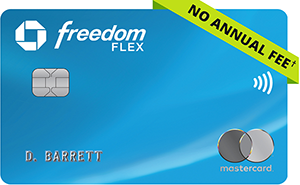
Chase makes two no-annual-fee cards aimed at the same person: Freedom Unlimited and Freedom Flex. Same issuer, same Ultimate Rewards points, same lack of annual fee. The difference comes down to how you want to earn rewards — set-and-forget flat rates, or actively managed rotating categories.
Here's how to figure out which one fits you.
The earning rate difference
| Chase Freedom Unlimited | Chase Freedom Flex | |
|---|---|---|
| Annual fee | $0 | $0 |
| Welcome bonus | $200 after $500 in 3 months | $200 after $500 in 3 months |
| Base earn rate | 1.5% on everything | 1% on everything |
| Bonus categories | 3% on dining, 3% on drugstores, 5% on Chase Travel | 5% on rotating quarterly categories (up to $1,500/quarter), 3% on dining, 3% on drugstores, 5% on Chase Travel |
| Foreign transaction fee | 3% | 3% |
The headline difference is in the base rate. Freedom Unlimited earns 1.5% on every purchase, no thinking required. Freedom Flex earns 1% on purchases that don't fall into a bonus category — but offers a 5% bonus on whatever category Chase rotates in for the quarter.
The rotating categories on Freedom Flex change every three months. Past examples have included grocery stores, gas stations, restaurants, Amazon, drugstores, Walmart, streaming services, PayPal — Chase mixes them up. You have to activate the category each quarter, and the 5% rate is capped at $1,500 in spending per quarter. After the cap, it drops to 1%.
The math on which earns more
For someone spending $2,000/month entirely outside bonus categories:
- Freedom Unlimited: $2,000 × 1.5% = $30/month → $360/year
- Freedom Flex: $2,000 × 1% = $20/month → $240/year (assuming none of it falls in the rotating category)
Big gap.
But add the rotating category. Say you spend $500/month on whatever quarter's bonus category — gas, groceries, etc. — and you stay under the $1,500/quarter cap.
- Freedom Unlimited: ($1,500 × 1.5%) + ($500 × 1.5%) = $30/month → $360/year (no bonus, just the flat rate everywhere)
- Freedom Flex: ($1,500 × 1%) + ($500 × 5%) = $40/month → $480/year (bonus category beats flat rate when you can actually hit it)
So if you reliably spend in the rotating category, Freedom Flex wins. If you don't — or if you forget to activate the bonus, or if the category doesn't fit your spending — Freedom Unlimited's flat 1.5% catches up fast.
The activation problem nobody talks about
Freedom Flex requires you to activate each quarter's bonus category. You log into your account or click a link in an email, click a button, and the bonus is live for the next 3 months.
If you forget to activate? You earn 1% on those purchases. No retroactive credit.
This catches a lot of people. Chase usually emails reminders, but if you're not paying attention to credit card emails, you'll miss it. Freedom Unlimited doesn't have this problem — there's nothing to activate, you just earn 1.5% on everything always.
If you're the kind of person who'd actually open the activation email and click the button every three months: Freedom Flex's potential payoff is real. If you're not: Freedom Unlimited will earn you more in practice.
Both cards earn Chase Ultimate Rewards points
This is where these cards quietly outclass most no-fee cash back cards. The cash back you earn is technically Chase Ultimate Rewards points at 1 cent per point. So 1.5% cash back = 1.5 points per dollar.
If you ever own a Chase Sapphire Preferred ($95/year) or Chase Sapphire Reserve ($550/year), the points you've earned on these no-fee cards transfer over and become eligible for Chase's transfer partners — Hyatt, United, Southwest, etc. — where they can be worth 1.5-3 cents each.
In other words: holding a Freedom Unlimited or Freedom Flex alongside a Sapphire card turns your "cash back" into transferable travel points worth 50%+ more than face value. That's not true of most no-fee cash back cards.
Other features to consider
Cell phone protection. The Freedom Flex offers up to $800/claim in cell phone protection when you pay your phone bill with the card. The Freedom Unlimited doesn't. If you'd actually use this benefit (cracked screens, lost phones), it's a meaningful tilt toward Flex.
Purchase protection and extended warranty. Both cards offer these benefits at similar levels.
Purchase APR. Both cards offer 0% intro APR on purchases for the first 15 months. Useful if you're financing a big purchase and can pay it off in that window.
Who should pick which
Get the Freedom Unlimited if:
- You want zero effort — no activations, no category tracking
- Your spending is spread across many categories with no clear pattern
- You'd put it as your "everything else" card alongside a more specialized card
- You forget about credit card emails and would skip the quarterly activations
Get the Freedom Flex if:
- You're disciplined enough to activate quarterly categories
- You consistently spend $1,500/quarter in commonly-rotated categories (groceries, gas, dining)
- You want cell phone insurance
- You're already running a multi-card strategy and need a "category card" specifically
Can you have both?
Yes. There's no rule against holding both cards, and many rewards-focused people do exactly that. You'd use the Freedom Flex for activated 5% categories and the Freedom Unlimited for everything else, capturing 1.5% on non-category spending instead of 1%.
The catch is the Chase 5/24 rule. Chase will deny applications if you've opened 5 or more credit cards from any issuer in the last 24 months. Both Freedom cards count toward that limit. If you're going to apply for both plus eventually want a Sapphire Preferred or Sapphire Reserve, plan the order — Sapphire approvals are stricter and you don't want to burn 5/24 slots if you might get denied for the one you really want.
Bottom line
For most people who want a single no-fee Chase card and don't want to think about it: Freedom Unlimited.
For people who want maximum rewards and don't mind doing some quarterly admin: Freedom Flex.
For rewards optimizers who want both — or who are building toward a Sapphire card — getting both makes sense, in the right order.